Oscar Bohórquez Musical Profile – Strad For Lunch


This is the profile and interview portion of a 64-minute music documentary “Strad For Lunch” that I recently edited and helped to shoot and produce. The film, directed by Marianne Hettinger, is about the US concert recital debut of the young German born violin virtuoso Oscar Bohorquez . In the performance which took place on March 7th, 2012, he plays a very rare Stradivarius violin. The concert took place at the WMP Concert Hall in New York City, with an all-Argentinian program of works by Ginastera, Ugarte, Beytelmann and Guastavino.

For more information about the director and/or the film, which includes a multi-camera live performance, go to:   http://www.mariannehettinger.com/rom-com-films-with-dance.html

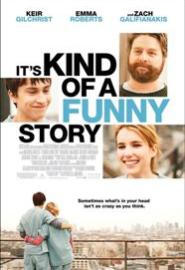
It’s Kind of a Funny Story – Film Review

ItsKindofaFunnyStory

It’s Kind of a Funny Story
Written and directed by Anna Boden and Ryan Fleck
Review by Thomas W. Campbell

On September 14, 2010 I did a Q & A with cast and crew of It’s Kind of a Funny Story. The filmmaking partners Anna Boden and Ryan Fleck were young, sharp, engaging and fun and Emma Roberts, of Nancy Drew fame, was engaging as well. Zack Galifianakis came in late (others have done it, we’re just glad to have you here) and then pretended to fall asleep the moment he sat down. It was perplexing, and extra fun when he finally woke up. They cared about the small film and we discussed the research and character work that were part of the film experience.

Link to original NBR review

It’s Kind of a Funny Story is kind of a comedy about a subject that isn’t easy to find the humor in. The main characters – Craig, a suicidal 16 year old boy, Bobby, a suicidal 40-something man, and Noelle, a 17 year old girl with her own problems – find each other in a Brooklyn psychiatric ward where their lives become intertwined. Based on a novel by Ned Vizzini, who ended up in a psychiatric ward himself because of the pressures to repeat the success of his first book, Funny Story is the third feature film written and directed by the filmmaking team of Anna Boden and Ryan Fleck.

As in Boden and Fleck’s previous features, Half-Nelson and Sugar, the theme is one of discovery and overcoming odds. The story is told from the point-of-view of Craig, who checks himself into a mental hospital only to discover that the youth ward is closed to renovation and he will have to stay with the adults. Craig is a middle class boy with too much pressure on his shoulders. Surprised and overwhelmed to have been accepted into the most elite private school in Manhattan he has become an outsider among his own friends. Adding to his angst, the girl he likes has become his best friend’s girlfriend and his father relentlessly pressures him about career achievement. And he seems to have a chemical imbalance for which he has stopped taking his medication.
Continue reading

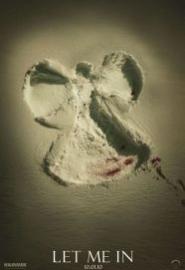
Let Me In – Film Review

Let Me In

Let Me In
Directed by Matt Reeves
Review by Thomas W. Campbell

Directed and adapted by Matt Reeves (who worked in television before directing Cloverfield in 2008), Let Me In (2010) is an inspired and faithful remake of Tomas Alfredson’s exceptional 2008 film Let The Right One In. Based on the book and original screenplay by John Ajvide Lindqvist, the new film tells the story of two 12 year olds who live in a small town, alienated from everyone else. Owen, played by Kodi Smit-McPhee (The Road) has lived there his whole life and just seems “different” -; he is quiet, rail-thin, and extremely private. Of course this makes him a perfect target for school bullies and one boy in particular is determined to make Owen’s life one of fear and dread. Chloe Moretz (Kick-Ass) plays Abby, a shy twelve year old, who moves into the apartment next to Owen. They meet one night in the snowy courtyard -; her bare feet the first sign that something is seriously different about her. When Owen discovers that his new friend is a vampire who must drink human blood he’s already in too deep to drop her as a friend.

Continue reading

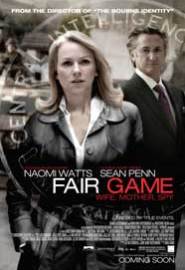
Fair Game – Film Review

FairGame

Fair Game
Directed by Doug Liman
Review by Thomas W. Campbell

I did a Q and A with Doug Liman following the National Board of Review screening of
Fair Game on October 28, 2010. Liman is sharp and was open to discussing the political real-life story that his film took on and technical/creative aspects of production – specifically the cinematography and editing.

Link to original review at NBR website

In Fair Game, director Doug Liman and his script writers (Chez and John-Henry Butterworth) take on the architects of the war with Iraq and lay bare the facts of an American betrayal in their dramatic retelling of the experiences faced by CIA agent Valerie Plame (Naomi Watts) and her husband Joe Wilson (Sean Penn), the former United States ambassador to Niger. Fair Game is a classic “based on real events” story that works for all the right reasons. Hoping to find the missing ingredient to rationalize an invasion of Iraq following the September 11, 2001 attacks, the Bush Administration turned to Ambassador Joe Wilson, who faced down Saddam Hussein in a successful effort to evacuate Americans and other foreigners during the first Gulf war. This time the mission was to find evidence of uranium sales by the Nigerian government to Iraq – to prove that Saddam Hussein was still actively building weapons of mass destruction even though his nuclear capability was dismantled after the Kuwait conflict. This would be the smoking gun to complete the swagger of those in the highest level of power in the Bush administration. Wilson’s trip to Niger, a region he had great first-hand familiarity with, was the great hope of those who were already planning the next American war. Unfortunately for the administration it was a dead end. Even more unfortunate, though, was what happened next.
Continue reading

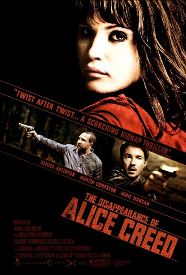
The Disappearance of Alice Creed – Film Review

TheDisappearanceofAliceCreed

The Disappearance of Alice Creed
Directed by J. Blakeson
Review by Thomas W. Campbell
Link to original review at the National Board of Review

The Disappearance of Alice Creed (2010) is a low budget exercise in minimalism that hangs its quirkiness on a mysterious kidnapping.  It is the first feature film written and directed by J. Blakeson, and was shot on Isle of Man in Great Britain by Philipp Blaubach (The Escapist).

The story, which opens as a mystery then settles into a creepy and suspenseful thriller, is completely restricted to the lives of three people: Vic, the head kidnapper (Eddie Marsan), Danny, the second kidnapper (Martin Compston), and Alice, the victim (Gemma Arterton). Tension builds as secrets are revealed that ramp up the danger–turning an “ordinary” abduction into a continuously evolving series of confrontations.

The roots of the film are obviously in the theater–with only three characters and at least 80 percent of the action taking place in an apartment. The simplicity of the film’s style, though, becomes its greatest strength. There are no elaborate camera movements–it is shot in a matter-of-fact way that lets the acting take precedence. The film’s stylistic control mirrors the attempts by each of the characters to stay in command of their feelings even as their careful plans fall apart. Blakeson pulls it off in a way that makes the story work on an emotional level with only a few locations and no special effects. Like the films and theater of David Mamet, Blakeson uses an almost abstract way of portraying the competitiveness and frustration of the male species through elliptical and repetitive dialogue. We are made to wonder from the beginning what exactly is going on and who are these odd men who act with such precision, calculation and undefined rage bubbling so close to the surface.
Continue reading

Babies – Film Review

Babies

I met with cinematographer and director Thomas Balmés following an April 26, 2010 National Board of Review screening of his new film Babies. Traveling the world to document the lives of four babies, who are developing in front of your eyes, is a unusual job. It was a lot of hard work, as Balmés graciously explained.

Babies
Directed by Thomas Balmés
Review by Thomas W. Campbell
Link to original NBR review

Babies (2010) is a delightful and unusual documentary that follows a year or so in the lives of four children -; without commentary, interviews or text (except for the names of the children, which we see only once). It’s a mesmerizing and nearly flawless film -; created in a strictly observational style using the “direct cinema/cinema verité” techniques of pioneering filmmakers Frederick Wiseman and the Maysles brothers. Wiseman became famous for making films that unsparingly chronicled the inner workings of institutions -;with intentionally generic sounding names like Hospital, Basic Training, High School, Central Par. The Maysles (cinematographer Albert and sound recordist David) made films that often focused on unusual individuals, events or artists (Salesman, Grey Gardens, Christo in Paris). Wiseman and Albert Maysles are still alive and making films and Babies is firmly in the tradition of their best work.

Babies is directed and shot by Thomas Balmés, who’s past work includes A Decent Factory (2004), in which he investigates how a Nokia Cell phone factory is run in China, and How Much is you Life Worth? (2007), which follows the internal workings of a personal injury law firm. Balmés spent a great deal of time in preproduction searching for the right families to follow and ultimately chose four stable nurturing sets of parents who would provide the supportive care he felt was central to the theme of the film. The film intercuts between four babies on four continents: Mari (Tokyo), Hattie (San Francisco), Bayar (Namibia) and Ponijao (Mongolia).
Continue reading

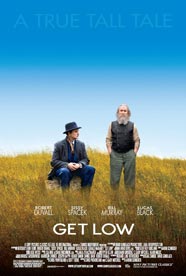
Get Low – Film Review

GetLow

Get Low
Directed by Aaron Schneider
Review by Thomas W. Campbell

I met members of the Get Low production following the NBR screening of the film on July 19, 2010. Director Aaron Schneider, Robert Duvall, Bill Murray, producer Dean Zanuck, and Sissy Spacek gathered to talk about the film. It was a fairly serious discussion with Duvall especially being in somewhat ornery demeanor, still in beard and seemingly in the character of “Bush” Breazeale. Much of our talk centered around finding the right locations, the value of the vintage wardrobe, and capturing Duvall’s big speech at the end in a long duration shot.

Link to original NBR review

Get Low, the first feature film by cinematographer/director Aaron Schneider is a self-proclaimed “true tall tale.” It’s the quirky story of Felix “Bush” Breazeale, a recluse played with sly humor and a straight face by Robert Duvall, who comes out of the hills and into a small Tennessee town with a simple request. He wants to arrange a funeral party–and invite everyone who ever heard of him (and anyone else who’s interested) to come and tell a story. The kicker is he wants to do it now–while he is alive to enjoy it. Nobody has heard of such a thing and he is turned down flat by the local minister. Bush has a bad reputation–some say he’s a killer, he chases kids off his property with a shotgun, and he’s an ornery old loner. But the conversation in the church between Bush and the minister is overheard by Buddy (Lucas Black), a young funeral assistant with a wife and new baby who could use a financial break. His boss (Bill Murray plays Quinn with the deadpan humor he’s known for) is looking for business in a town where nobody seems to die. He does everything he can to get Bush’s “Hermit Money” but nothing with the old man is as simple as it seems.
Continue reading

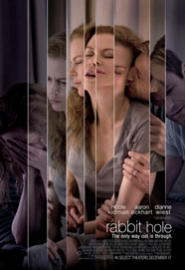
Rabbit Hole – Film Review

RabbitHole

Rabbit Hole
Directed by John Cameron Mitchell
Review by Thomas W. Campbell

On November 16, 2010 I did a Q and A with David Lindsay-Abaire, Nicole Kidman, John Cameron Mitchell, and Aaron Eckhart following the NBR screening of Rabbit Hole. It was a treat to have producers, actors, the director and the writer in the same room. Kidman’s commitment to the film was evident as she discussed her creative relationship with the process of putting together the film and the great degree of freedom granted to Lindsay-Abaire in adapting his own play to the screen.

Link to original NBR review

Rabbit Hole is a loving adaptation of David Lindsay-Abaire’s 2006 Pulitzer Prize winning play of the same name. Although the film, based on it’s theme, will probably not become an adored holiday classic the journey from play to screen has been unusual in it’s fidelity to the original source and quite successful in terms of storytelling and performance. One of the first and most unusual aspects of the project is that the playwright was hired to adapt his original work, without a co-writer, to the screen. Producer Nicole Kidman and director John Cameron Mitchell, both with experience in theater, felt so strongly about the play that they were comfortable handing the screenplay to Abaire. The result is a film that reflects the original work–a young couple lose their son in an accident that remains mysterious to the viewers and to themselves–but is adapted in ways that subtly and effectively fit the needs of cinema.
Continue reading

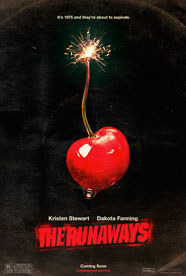
The Runaways – Film Review

TheRunaways

The Runaways
Directed by Floria Sigismondi
Review by Thomas W. Campbell

On March 17, 2010 I did a Q and A with director Floria Sigismondi, Kristen Stewart and Dakota Fanning following the NBR screening of The Runaways. Stewart and Fanning were very young that day, thrilled to be back together for the publicity tour and making me feel like the professor keeping one eye on the adult while hoping to keep the kids out of trouble. It was fun and a bit unpredictable, like the movie itself.

Link to original NBR review|

The Runaways, based on the short eventful career of one of rock’s first all-girl bands, captures the time and place of Southern California, mid-to-late 1970’s, with energy and style. The Runaways were formed in 1975, breaking the mold of musical groups until that time, challenging the male-dominated rock scene. Put together by a musician-manager-provocateur named Kim Fowley (played with crazed bravado by Michael Shannon), the band was embodied by 15-year-old beauty Cherie Curie (Dakota Fanning) and slightly older leather-tough Joan Jett (Kristen Stewart). It was a time when kids were all forming bands, but there were few if any role models for a young girl who wanted to rock–and no all-girl bands at all. The Runaways is based in part on the book “Neon Angel: the Cherie Currie Story” by Cherie Currie and is directed by Floria Sigismondi, an artist and photographer who has made memorable music videos with David Bowie, The White Stripes, Sheryl Crow, and others. Sigismondi has created an exceptional film that is part biography, part musical history, and best of all a gritty but fun coming-of age-story about a group of girls who want to do what others feel they are incapable of–be rock-and-roll stars.

Continue reading

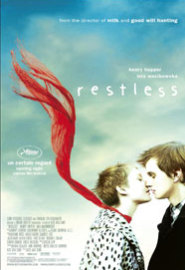
Restless – Film Review

Restless

Restless
Directed by Gus Van Sant
Review by Thomas W. Campbell

On September 14, 2011 I did a Q and A with Gus Van Sant following the NBR screening of his film Restless. Van Sant is a thoughtful and caring man who enjoys discussing film and the creative process as much as anyone I have met. He was particularly interested in praising his young actors for their daring and intuitive approaches to their work.

Link to original NBR review

Restless, Gus Van Sant’s new film, opens with a series of shots revealing a somewhat overcast Portland, Oregon as the bouncy Beatle’s song “Two of Us” is heard on the soundtrack. At first the song seems a mysterious choice, with it’s chorus about “going home”. Neither character we are about to meet is in any process of going home–if anything they are preparing to leave their home for new experiences. But the song is about two people “Sunday driving, not arriving, on our way back home.” This perfectly fits Van Sant’s gentle but unsentimental view of life–especially as lived by the young. This is a story about two people who find each other–who “Sunday drive and don’t arrive” – but home is not part of their lives. It’s something they might dream about, knowing they will never really be there.

Restless is based on a short play by Jason Lew that was developed into a children’s book, before finally becoming a script. It landed on Van Sant’s desk via producer Dallas Bryce Howard and is a stripped-down story that takes some gentle but surprising turns as the characters are challenged by the tragic circumstances of their own lives.

Continue reading