
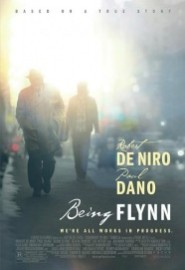
I did a Q and A on February 28 with Director Paul Weitz and Co-star Paul Dano following the pre-release screening of Being Flynn for members of the National Board Review. We enjoyed discussing the adaptation of Nick Flynn’s complex memoir “Another Bullshit Night in Suck City” and the ways that the cast worked together to develop the boldly crafted characters from the book.
Originally published on March 2nd on the website of The National Board of Review
Being Flynn
A film by Paul Weitz
Review by Thomas W. Campbell
Paul Weitz has a touch for comedy – his previous films include the franchise establishing American Pie (with his brother Chris), About a Boy, an adaptation which brought him a co-writer Academy Award screenplay nomination, and a perfectly adequate continuation of the Ben Stiller/Robert De Niro Meet the Parents series (Little Fockers). Being Flynn, his latest film, which he also wrote, is based on the novel “Another Bullshit Night in Suck City: A Memoir” – a complex, emotionally gripping and decidedly unfunny story. Why did Wietz make such a genre leaping commitment to a story so different in style from his previous work? And in doing so how did he manage to nail it so perfectly, to transform a book with almost no dialogue based around a painful relationship of loss and betrayal into a film that engages from start to finish?
Being Flynn is a deft adaptation of a sprawling, non-linear memoir about abandonment, self-doubt, and loneliness. It’s an emotionally challenging story about a young man named Nick Flynn, abandoned in youth by his father, left to cope with his mother’s suicide, alone without anyone to point him towards answers – or even useful questions. Working in a homeless shelter as he tries to sort out his own issues, Nick is abruptly confronted with his fathers reappearance after 18 years of silence. Angry and confused, Nick is determined to prove that he has no need for reconciliation. Weitz uses a narrative technique he honed in About a Boy, which begins with alternating scenes narrated by the bachelor (Hugh Grant) and the boy of the film (Nicholas Holt). Being Flynn pushes the dual narrative concept even further. As we meet Jonathan Flynn (Robert De Niro) going about his business as a cab driver we hear De Niro’s unmistakable voice announce that he is one of the world’s greatest writers. Not a good writer, one of the greatest. Such bravado, immediately belied by the circumstances of his work, is wonderfully Rupert Pupkin like in self aggrandizement, and also harks back to the attitude that of another taxi driver he once played. As we wonder whether to laugh or cry the film cuts to a Nick Flynn (Paul Dano), a young man scribbling frantically on a yellow pad late in the night. His voice over tells us this is not his father’s story, it is his own. From the opening moments the film is about trying to understand why father and son have gotten to where they are – it engages us early with the mystery of the past and a spiraling-down present day action.
This is serious stuff, denser and more dangerous than any of Weitz’s previous work and seemingly an abrupt stretch coming off his recent entry in the Focker series. But Weitz nails it – his adaptation of the novel is clear, poignant, funny and emotionally compelling. Hardly new to the material, Weitz has been attached to the book since first reading it in 2004, shortly after it was published. The true story he encountered – about a fragmented and disturbing father/son relationship – troubled and fascinated him. He saw echoes of his own relationship with his father and was attracted to the complexity of the narrative. It took about eight years, a number of possible studios, and according to his own count, thirty drafts of the screenplay until finally being able to decode the tale into a film script that both he and novelist Nick Flynn felt ready to proceed with.
 twcampbell