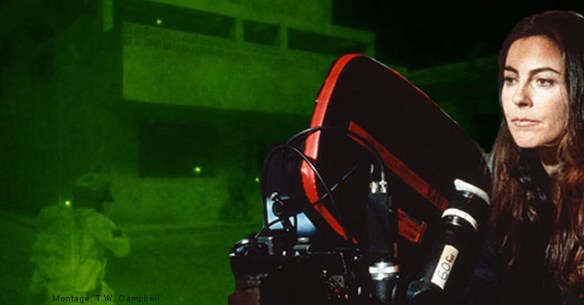
The Messenger – Film Review

TheMessenger

The Messenger
Directed by Oren Moverman
Review by Thomas W. Campbell

On November 10, 2009 I did a Q and A with director Oren Moverman, Ben Foster and Woody Harrelson after the NBR screening of The Messenger. Moverman is a wonderful craftsman of style and story and talked at length about shot set-ups and the importance of the long take to his story. Harrelson was tentative at first, wondering it seemed where I would be coming from. Once we got into film talk he perked up and became quite engaging. I asked Foster about his acting style, especially the way he seems to use space (and to close space) between himself and characters and he insisted that this was purely an instinctive element of his technique.

Link to original NBR review

The Messenger was written and directed by Oren Moverman, a screenwriter (I’m Not There, Jesus’ Son, Face) making his feature directing debut. Working with cinema-tographer Bobby Bukowski (Phoebe in Wonderland, The Stone Angel), Moverman has created a film that takes on controversy with a perfect balance of empathy and self-discovery.

The Messenger opens with a closeup of an eye, overexposed to nearly white. A hand comes into frame and puts eyedrops onto the cornea, the drops spilling like tears. The damaged eye (and leg) belong to Montgomery, a “hero” soldier back from Iraq waiting for his new orders. Portrayed by Ben Foster, memorable as the charismatic villain in 3:10 to Yuma, Montgomery is an intense, troubled man attempting to define his moral bearings in a world that seems suddenly foreign. He is assigned to the Army Casualty Notification Services and feels completely unprepared. “I haven’t had grief counseling yet,” he says at the interview. This dismays his senior partner, Officer Tony Stone, played with a wound-up intensity by Woody Harrelson. Stone, as tough as nails, sees no grey areas in the job. There are rules that must be followed: you give the message and only the message; you act with honor; you walk away from any emotional or physical encounter.
Continue reading

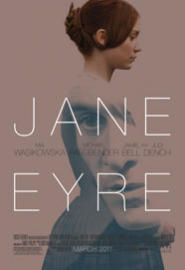
Jane Eyre – Film Review

JaneEyre

Jane Eyre

On March 10, 2011 I did a Q and A with Cary Fukunaga and Mia Wasikowska following the NBR screening of Jane Eyre. Much of the very civilized conversation centered on the value of realism – and how the specific rural English locations sealed the deal in terms of authenticity, especially Haddon Hall in Derbyshire as the Thornfield castle.

Link to original NBR review.

Jane Eyre, directed by Cary Fukunaga (Sin Nombre), is the first major film adaptation of Charlotte Bronte’s ubiquitous 1847 novel since Franco Zefferelli’s 1996 version starring Charlotte Gainsbourg as Jane and William Hurt as her benefactor/tormentor Rochester. Working with producers Alison Owen (Shaun of the Dead, The Other Boleyn Girl) and Paul Trijbits (Fish Tank) and money from BBC television, Fukunaga has made a film that has the look and feel of a classic yet takes some chances with the material that might risk the “can’t be too faithful to the source material” crowd. Faced with the seemingly impossible task of coming up with a definitive version of a book and story that nearly everyone seems to know (there have been over 25 film and TV adaptations so far) Fukunaga and his team have created a film that captures the spirit and look of the novel in a way that entertains and feels right.

Casting a classic is always difficult–if you’ve read the book you have already imagined the perfect manifestations of the central character–probably as people who are in many ways similar to yourself. A film like Jane Eyre, with so many versions already casting impressions on us, can create confusion before we even step into the theater. Ms. Eyre, a teenager in the bulk of the book, is often cast in the Hollywood tradition of the established star–an older successful “name.” Rochester, the mysterious and sometimes coarse man who owns the strange castle she ends up at, seems to be a particularly troubling role to get right. He should be handsome, but not a dandy, brooding but not really disturbed, with a mystery but not unable to appreciate beauty when he stares her in the face. Played by Orson Welles in the Hollywood 1940’s version (to Joan Fontaine’s too old Jane), he seemed a bit “Wellesian,” as though at any moment he might stand up tall and declare “I am Charles Foster Kane!”. William Hurt, in Zefferelli’s version felt a bit eclectic–filled with the same neurotic tics and hesitations we have come to expect from Hurt (History of Violence, for instance).
Continue reading

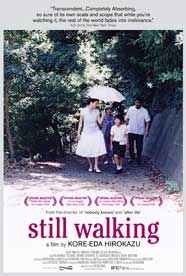
Still Walking – Film Review

StillWalking

Still Walking

Directed by Hirokazu Koreeda

Reviewed by Thomas W. Campbell

Originally released in August of 2009

Link to NBR Review

Still Walking, the new film by Hirokazu Koreeda, explores the complexities of family life in modern Japan, in part through the struggles of a male character who ultimately finds some kind of redemption. Two other recent Japanese films have explored this theme with style and expert storytelling: Tokyo Sonata by Kiyoshi Kurosawa, about a man ashamed at the loss of his middle- class job, and Departures by Yojiro Takita, the story of a man who leaves his wife and finds solace cleansing corpses in burial ceremonies, a task considered “untouchable” in some societies.

Still Walking is an elegant and subtly directed film that explores similar ground but with less physical action and a great deal of careful interaction. Ryoto returns to visit his aging parents in the home where he grew up on the fifteenth anniversary of an event that still haunts the family. The oldest son died trying to save a drowning friend, and his memory is held in such high esteem that it overshadows any attempt that Ryoto makes to establish his own identity in the eyes of his parents. Complicating the visit is the past of his new wife, a widow with a young son. While Ryoto and his family travel on the bus, we meet his mother, Toshiko, preparing vegetables in the kitchen with her daughter Chinami.  Chinami is a free spirit who has no use for the proper preparation of radishes, and the contrast with her mother’s culinary gravity sets a tone of levity that persists throughout the story, never letting even the most serious moments become too weighty or hopeless.

The effect of the careful compositions, gradual pacing, and subtle and realistic acting is that the storytelling draws the viewer into the complex emotions of the family gathering, slowly revealing the strained state of each relationship. Toshiko and her husband Kyohei do not get along, although she seems resigned to move forward in all the necessary ways. The father was a doctor, but old age and his failing health have forced him into retirement, resigning him to long lonely walks and much time alone in his once home office. When Ryoto arrives it is the mother’s seeming good nature that makes things bearable, despite the haunted memories and his father’s unhidden contempt for his career as an art restorer. Adding to Ryoto’s burden is the fact that he is currently unemployed and his shame will not allow him to discuss this with his parents. Although the story is shaped around the son’s disappointment, it is in the mother’s actions that emotional conflict and resolution are most fully explored. Events that at first seem benign, and even humorous, are revealed to carry coldly executed intention and even cruelty. Relationships that existed in seeming stasis for many years are seen from new and unexpected angles.

Still Walking leaves us with a series of sometimes humorous and always moving impressions, as though we had been peering through window shades for the entire visit, watching the slow unraveling of a graceful but dysfunctional family, while also learning their deepest secrets.

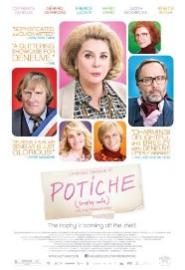
Potiche – Film Review

Featured

Potiche

Potiche
A film by François Ozon
Review by Thomas W. Campbell

In March of 2011 I talked with Catherine Denueve following a screening of François Ozon’s comedy Potiche. The screening was for members of the National Board of Review. Denueve spoke about her pleasure of working with the young director, pairing up against the legendary Gérard Depardieu, and her continued love of acting. She was as graceful and beautiful as one would expect from an icon of modern cinema.

The review originally appeared here on the web site of the National Board of Review.

Potiche literally means a large impressive looking vase that is displayed to the owner’s benefit. Another definition, referred to in François Ozon’s latest film, is a “Trophy Wife”–a beautiful woman (or man as the case may be) who paid for and displayed to the husband’s (or wife’s) benefit. Catherine Denueve play Suzanne Pujol, the wife of a rich and unpleasant factory owner who has become, in her own words, “The Queen of kitchen appliances.” Ms. Denueve has filled world cinema with some of the most memorable roles of the last 45 year–as the troubled Severine in Louis Bunuel’s Belle de Jour, as the psychologically tormented Carole in Roman Polanski’s Repulsion, as Caroline Steiner, the wife of a Jewish theater owner in Nazi occupied France who falls in love with an actor played by Gérard Depardieu in François Truffaut’s The Last Metro. Potiche is the second film in which she has worked with Ozon, previously starring with an all-star ensemble cast in 2002’s Eight Women.

Potiche is an extremely enjoyable film that relies on carefully developed style, adept comic pacing, and the kind of character based humor that could fall flat if not done in the hands of a director capable of pulling it off. Potiche is a surprising departure for Ozon, who’s most memorable work has dramatic gravity that is anything but comic. Swimming Pool (2003) is a suspense film about a mystery writer (Charlotte Rampling) who leaves England to vacation at her editor’s French countryside cottage. A sudden visitor pulls her away from her work and ultimately draws her into a world of deception that might lead to murder. Hideaway (2009) tells the story of a young woman who loses her lover to a drug overdose then must struggle with the pregnancy she has been left alone to confront. Potiche feels like a new direction for Ozon, yet from start to finish it is accomplished, engaging, and a great deal of fun. The characters seem to have a strong resemblance to the good humored and playful ones in Truffaut’s lighter films (Day for Night, Jules and Jim) and the style of the film is just as colorful and intelligently created as in the recent work of Pedro Almodóvar.
Continue reading

Amour – Film Review

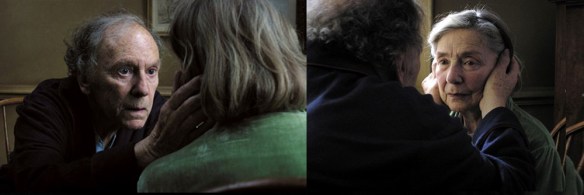
Amour montage

I met Michael Haneke on Thursday evening, October 4 2012, for a Q & A following the screening of Amour. He had literally just flown in from Europe for a weekend screening of Amour at the NY film film festival. Haneke, who is Austrian, speaks fluent French and German and also has a good grasp of the English language. Although the discussion took place mostly with the assistance of a talented and patient translator the director spoke directly to me, intent on making the most of every level of communication. Haneke knows filmmaking and was open to discussing story, acting, cinematography, set design and not hesitant to point out something I might have missed about his films. In Amour, for instance, there is an unusual moment (for him) when music overlaps two scenes that begin in the concert hall then cut to a later moment in the hall lobby. I mentioned that this was unusual in his films but he pointed out that he had used the technique before – and the ending of Code Unknown, in which a continuous drum track plays over related scenes between the main characters, immediately jumped to mind. Possibly sensing, and maybe appreciating, that I was giving a nod to the formal rigor of his style he crossed himself and said “mea culpa” for his sins (or for mine).
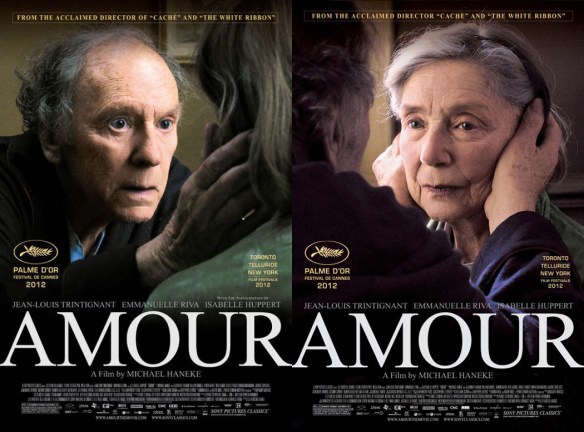
Amour posters

Amour
A Film by Michael Haneke
Review by Thomas W. Campbell

Amour, the new film by Austrian director Michael Haneke, is a transcendent work of art that provokes, engages but never embraces. It marks the return to the screen of two actors who are alive in the minds of anyone who enjoyed the classic art house cinema of the last 60 years. Jean-Louis Trintignant, who was the conformist in Bertolucci’s seminal 1970 film of the same name and also starred in such classic films as 1956’s And God Created Women (Ok, maybe not a classic), A Man and A Woman (1966), and Z (1969) plays Georges Laurent, a retired musician. Trintignant is 81 and was retired himself from filmmaking for 14 years before Haneke, who envisioned the role for only him, lured him back. Playing Anne, his wife, is Emmanuelle Riva, who’s very first role as Elle in Alain Resnais’s debut feature film Hiroshima, Mon Amour launched a 63 year career that includes such work as Jean-Pierre Melville’s Léon Morin, Priest (1961) and Krzysztof Kieslowski’s Three Colors: Blue (1993). Ms. Riva, who is 85, plays Anne, a retired concert pianist and teacher who has settled into a simple and comfortable life with a husband who clearly adores her.

After simple white-on-black opening credits the film starts at the end then takes us back just far enough into the lives of the couple to give some context to the depth of their relationship. The opening moment is the kind of blunt cut that Haneke loves to throw at the audience. From black a two panel door bursts open into a spacious Parisian apartment and policeman and building personnel barge straight at the camera and into the room. It’s an exhilarating moment that doesn’t let up as the police swiftly go into investigation mode. Cinematographer Darius Khondji, who shot the director’s 2007 remake of his own Funny Games, is up to Haneke’s demands, constructing the long and complex scene in a single shot. The police finally come to a locked and taped off room.  Covering their noses policemen open windows to air out the apartment while the commanders break through the second door. Inside they find a woman (Anne), deceased and laid out on the bed with yellow and white flowers spread carefully around her.

The first edit of the film is to a brief director’s credit, then to the second shot, which is also the second scene of the film. We meet Georges and Anne (Haneke’s central characters almost always have a variation of these names) in attendance at an old-world concert hall. Framed in a very wide shot that fills the screen with a theater audience facing the stage, it is as though we were on stage looking out at them. But they do not gaze directly at us, the audience on film looks diagonally to our screen right. The shot seems to last for a couple of minutes and somehow, from the first moments that the image appears, we find Georges and Anne amongst the hundreds of others, waiting for a performance to begin. In case we don’t see them someone passes by, forcing them to stand momentarily before sitting again. It is a masterful shot/scene that goes from the viewer “discovering” its essential meaning, then watching the Laurent’s viewing the stage, then to watching Georges looking at his wife, trying to understand something that remains unknown. It’s one of the simplest and boldest pieces of cinema of the year, and it is only the second shot of the film. In the third scene we are in the lobby and learn that the young musician (Classical musician Alexandre Tharaud) is Anne’s most talented former student. In a soundtrack moment that is rare in Haneke’s work, the piano performance continues over the post-performance lobby scene. (The director’s boldest instance of breaking his own rule is in Code Unknown (2001), when a montage tracks the actions of the central characters while a powerful unstoppable drum beat, introduced as the work of a group of deaf youngsters earlier in the film, fills the soundtrack.)

Haneke is a master of the long take and will use far fewer shots to cover a sequence than more commercial/mainstream directors. But his films seldom feel slow, in part because he so carefully creates unusual and effective structures for his stories. Amour is a departure, an exploration, as he has explained, in following the classical unities of action, place and time. Of course Haneke presents time for his own purposes and does not limit his story to 24 hours (part of Aristotle’s thesis), but the amount of compression that he does to the story is quite remarkable. We have no way of knowing how long the story takes place. We are kept off-balance because the very act of extracting time in a story also heightens the drama.

When the couple return home from the performance a bad omen awaits – someone tried to break in but they only managed to bend the lock plate. But Georges’s only concern is the effect on his wife – he tells her “don’t let this ruin your good mood.” It is soon clear that they are musicians, lovers of culture, music, classic books, and art. They seem to have everything they need or want.

At the morning breakfast table Anne goes silent and Georges gradually realizes that something is wrong. Haneke moves away from his use of long takes to a handful of shot/reverse shots as Georges holds Anne, and she is held by him. What would seem standard in other films stands out – the shots have a symmetry and grace that suggest something meaningful is taking place, that attention must be paid. George leaves the room – the camera follows him, and has left the water running in his concern to dress and seek help. As he searches for clothes to change into when the running water suddenly stops. When he returns to the kitchen Anne is completely unaware of her blackout. The descent begins, and it is a journey that neither Georges, Anne nor the audience are fully prepared to take.

We soon come to understand that Georges and Anne are completely alone and have only themselves. This is equal parts beautiful and horrifying. What are the limits to love that we face as we grow into old age? What can we do to help ourselves and to help the ones we love. How will we act when we are the ones who have become disabled by age? Can we ever really know what our response will be to something before we directly experience it?

Family is represented by their daughter, Eva, played by Isabelle Huppert, and her husband Geoff, played by William Shimell. They live far away and are infrequent visitors. As Anne’s condition worsens it becomes clear that Eva may (or may not) be well intentioned but is also looking for simple answers to a complicated and painful reality. But reality is seldom as simple as we would like, especially when looking in from the outside. The building superintendent and his wife are also helpful with small chores but their intermittent presence only accentuates how alone Georges and Anne are. When Anne returns from the hospital she asks George to promise that he will never send her back. This confuses and scares him but the intertwined nature of their shared fates is sealed when he agrees to not let her leave again.

What is different about Amour from Haneke’s previous theatrical films (after directing and writing in television he made The Seventh Continent, his first feature, in 1989) is the unprecedented degree that we are able to empathize and care for the main characters. Georges and Anne are in love (they seem to have spent most of their long lives together) and they have learned to respect and live with each other. But life has its built-in limitations. Citizen Kane, when Bernstein the publisher is talking about his own long life, he reflects on existence by saying “Old age is the one disease that we don’t look forward to the cure.” It is not fate, as in Funny Games, that brings punishment onto the Laurents. It is life itself. They are others in a long list of victims in Haneke’s films – but victims of the same fate that befalls each of us, no matter where our place in society may be. Haneke’s films are filled with people who are punished. In Funny Games, a film he liked so much that he made it twice, in German language (1997) and then ten years later with an American cast, an upper-middle class couple and their son are isolated and tortured in their own home. Even more unnerving is the fact that the boy who “directs” the whole affair also talks to the audience in a Brechtian sort of way, although his general attitude is more Grand Guignol. In Cache/Hidden (2005), Haneke’s most artistic and intellectual achievement until Amour, the lives of a well-to-do couple are wrenched from normalcy by a series of video tapes and drawings that demonstrate they are being watched and most likely stalked. In The White Ribbon (2009), an Austrian town at the turn of the 20th century (the time that the story takes place is not revealed until the end) is plagued by a series of violent events that inflict pain on adults, children and even animals. Even more disturbing is that the seemingly random acts begin to feel like a mirror to the nasty doings that go on behind the closed doors of the most “respected” village families.

Although it is hard to find anyone to empathize with in Haneke’s films there have been movements in that direction that prepare us for Amour. In Hidden, the Algerian man, who nearly became the adopted brother of the writer Georges when they were children, was victimized as a child and seems to have grown into a peaceful but very much defeated father. He may also be involved with the video tapes that the family receive but, as we find in most of Haneke’s work, the question can not really be answered. Depending upon what we choose to believe about the story, we are allowed to empathize, and even sympathize with him.  Funny Games dares us to identify with the family who suffer so completely at the hands of the two sociopaths while also attempting to force us to accept that what we really want in the movies (violence and action) is the very thing that sickens us once we really get it. It is in The White Ribbon that Haneke finally allows a bit of humanity to infiltrate his intentionally oppressive and astoundingly precise view of life. With a cast of characters larger that any of his other films (the village itself), and in need of a storyteller to help put the events into perspective, he introduces a youngish teacher (played by Christian Friedel), who is inquisitive, likable, and as an outsider, seemingly uninfected by the darkness creeping through the town. He is also the narrator of the story, speaking to us reflectively from many years in the future. Just as engaging is the chance encounter with a young girl riding through town on a bicycle who has come to the village as a nanny. The fumbling courtship, and ensuing relationship, is naively innocent and quite unlike anything we have come to expect from the director. It’s a glimpse, it seems, of what’s to come.

What is consistent about Amour (and continues to identify Haneke as one of the most auteur and uncompromising filmmakers of today) is the rigorous and obsessive way that he constructs his stories using the language of cinema. His reliance on the long take, his refusal to construct time using the classical tools of the shot/reverse shot and reaction shot (he relents a bit for Amour, as can be seen in the advertising which features alternating shots of Georges and Ann from the defining moment of the film), his almost total refusal to use non-diegetic (soundtrack) music (there are a few moments of it in Amour when he cuts from the unseen piano performance to the lobby, and the music continues although the performance has ended). It is also an axiom of the director’s work – and a reason that his films can be so frightening – that the most violent and transgressive moments will occur offscreen. Four of the five killings (including the dog) in Funny Games, the creation of the videotape in Hidden, all of the beatings and mutilations in The White Ribbon, the bank victims who are finally shot with the gun that changes many hands in 71 Fragments all happen off-screen. We are left to our imagination to “create” that which we did not witness. We can imagine who made the videotapes in Hidden but will never know. We can imagine how the young son of the property owner in The White Ribbon was beaten, but will never know. We can see for ourselves the destroyed and lifeless body of the son in Funny Games, or the back of the bank worker in 71 Fragments as his blood flows from him in seeming slow motion, but we will not have seen the violence that caused this. Off-screen space in Haneke’s films lurks around the corner like a hidden threat. And once he has conditioned us to use our imaginations to “see” the most horrible things he breaks his own rule and catches us off guard in the most brutal and effective ways – for instance in the shock cut to the beheading of the chicken and the out-of-the blue self-laceration of the the Algerian man in Hidden.

Haneke, more than any major director that I am aware of, makes us work to integrate (and understand) the story elements that he implies or simply leaves out. He is also a master of the soundtrack, using sound and the absence of sound to provoke, to create anxiety, to heighten suspense and to add mystery. Combined with his passion for the long take (he likens the technique to an attempt to create a more authentic experience for the viewer) the effect can be chilling – for example a single shot scene in Code Unknown in which Anne (Juliette Binoche), who we have earlier seen being terrorized as an actress on a low-budget thriller/horror movie, irons clothes in her kitchen while listening to the television news. Minutes into the shot she (and we) hear something in the distance. She turns down the television and listens for what seems a very long time to an indeterminate sound that could be someone in pain or could be something we just can’t understand. Making the moment even more complex, and possibly unknowable, is that we do not know what she already knows – or even what she is thinking. Some of the most memorable moments in Amour are driven by off-screen sound – the water that suddenly stops running as Georges dresses, Georges in the bathroom and the sound of Anne falling erupts from the silence, a bed-stricken Anne calls out from the other room for what seems to be her mother, the doorbell rings while Georges is brushing his teeth but nobody is there. Haneke, a native Austrian film maker who who began to make his films in France (and in the French language) with his fifth film (2001’s Code Unknown) has always executed language with precision and complexity. In Amour, for instance, a decisive action by Georges ultimately hinges upon the pronunciation and understanding of a single word. And the between-scene moments could fill a second film: Anne and Georges return from a hospital stay that we never see after her first stroke, Anne’s second stroke, the relationship of their daughter Eva and their son-in law.

Although it is Ann who must be cared for, it is through George’s eyes and experiences that the impact of her illness is made real. His devotion is eternal but his ability to shelter his wife, and himself, from the final stages of life is fleeting and ultimately ineffectual. Life that is truly shared is a yin-yang experience – the diminishment of one is also the loss of the other. Cause and effect takes its toll as though the life force was a single entity. The increasingly subjective descent that Georges experiences, the visual and aural manifestation of his pain and suffering in dreams, visions, and odd occurrences (the reoccurring visit by a street pigeon may or may not have meaning) has brief echoes in the memories/dreams that Georges the writer experiences in Hidden. But the degree that we experience this inner world is also new ground for Haneke, a dip into the subconscious and the surreal that feels quite refreshing.

Amour is an experiment in humanity for Haneke – he has said that the story came from experiences that he went through with someone close to him. But “humanity” is a relative term and for viewers conditioned to the soothing balms of commercial cinema, who are used to the softening of reality that makes even the gravest of events “consumable” and open to happy endings, Amour will most likely seem depressing and demanding. But isn’t it the nature of art to open our eyes to reality, and isn’t cinema, at it’s highest level, the most revealing and penetrating of art forms? Imagining the reality of old age, for ourselves and our loved ones, is one of the great taboos of modern life. Amour, Michael Haneke’s latest masterpiece of ferocious and unsparing cinema, is a direct assault on our most existential blind spot. Be prepared to face a future that you might not want to see coming.
NBR Awards – Kathryn Bigelow Rules

Kathryn Bigelow Wins Big with the NBR

The National Board of Review, an organization I belong to, released their annual film awards on Wednesday, December 5. Below is a partial list – you can go here to read the complete list of awards.

Best Film: ZERO DARK THIRTY

Best Director: Kathryn Bigelow, ZERO DARK THIRTY

Best Actor: Bradley Cooper, SILVER LININGS PLAYBOOK

Best Actress: Jessica Chastain, ZERO DARK THIRTY

Best Supporting Actor: Leonardo DiCaprio, DJANGO UNCHAINED

Best Supporting Actress: Ann Dowd, COMPLIANCE

Best Original Screenplay: Rian Johnson, LOOPER

Best Adapted Screenplay: David O. Russell, SILVER LININGS PLAYBOOK

Best Animated Feature: WRECK-IT RALPH

Special Achievement in Filmmaking: Ben Affleck, ARGO

Breakthrough Actor: Tom Holland, THE IMPOSSIBLE

Breakthrough Actress: Quvenzhané Wallis BEASTS OF THE SOUTHERN WILD

Best Directorial Debut: Benh Zeitlin, BEASTS OF THE SOUTHERN WILD

Best Foreign Language Film: AMOUR

Best Documentary: SEARCHING FOR SUGAR MAN

William K. Everson Film History Award: 50 YEARS OF BOND FILMS

Best Ensemble: LES MISÉRABLES

Spotlight Award: John Goodman (ARGO, FLIGHT, PARANORMAN, TROUBLE WITH THE CURVE)

NBR Freedom of Expression Award: THE CENTRAL PARK FIVE

NBR Freedom of Expression Award: PROMISED LAND

Three Levels of Nolan

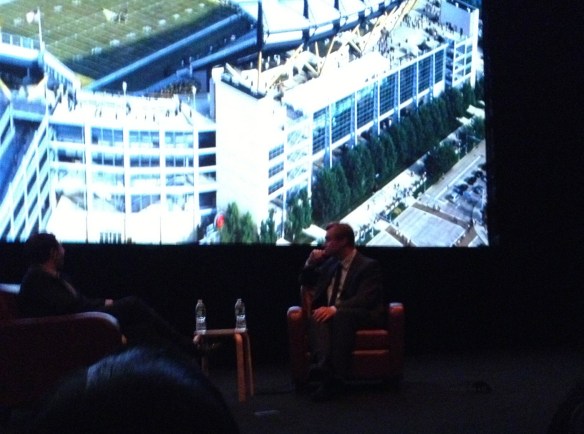
Scott Foundas and Christopher Nolan talk Dark Knight, Wednesday, November 11, 2012

Scott Foundas and Christopher Nolan talk Dark Knight, Wednesday, November 28, 2012


Thoughts on the recent Lincoln Center/Film Comment evening of discussion between contributing editor Scott Foundas and Christopher Nolan

On Wednesday, November 28, 2012 Lincoln Center and Film Comment brought Christopher Nolan to a public audience to discuss the Dark Knight trilogy.  The discussion itself lasted for about an hour and a half (with clips from the trilogy). Then there was a free special 12 page edition of Film Comment with beautiful images, and a printed conversation between Foundas and Nolan. Drilling deeper there’s a link to a page with another, longer version of the discussion, and a few other articles (and a video). I look forward to reading the longer versions of the discussion – meanwhile here are a few things I learned from the evening.

1- Christopher Nolan, known for his uncompromising adherence to shooting on film instead of digital video, also uses the “photochemical process” in postproduction. Accomplished for getting as much of the film within camera as possible, Nolan still matches back, as much as possible, to the original camera negative.

2- The transition happened rapidly, but now most films that involve any level of special-effects or blessed with at least a modest budget go through what is known as the DI or “Digital Intermediate” stage. Film is digitized to take advantage of color correction, effects, adding animation etc. Whether it was a slip of the tongue, or intentional, at one point Christopher Nolan called the process of going from film to the computer “digital interference”.

3- Scott Foundas is an excellent film writer and contributor to Film Comment. I’ve seen him do Q&A’s before the New York film Festival and his knowledge of film speaks for itself. But it was silly of him to say, after viewing the football stadium sequence in the third Dark Knight film, that it would be a crime if Nolan’s film doesn’t win a Special Effects Oscar. He must have missed Life of Pi, Cloud Atlas,The Avengers et al.

4- Nolan had Heath Ledger go to the source of Clockwork Orange, the book by Anthony Burgess, as they began to imagine who and what the Joker would be.

5- I’ve heard Nolan discuss the Dark Knight films three times and there’s no end to the amount of time I would designate in the future to hear him speak about his work. The event was barely an hour and a half including film clips – which is much too short. Especially when there was no Q&A involving the audience.

Compliance – Film Review

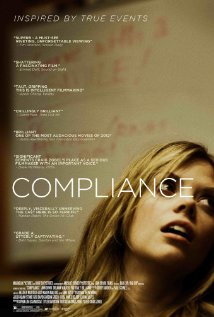
On August 14, 2012 I moderated a Q&A after the National Board of Review screening of Compliance with director/writer Craig Zobel and actress Ann Dowd. It was a relaxed and fun conversation, moving fluidly between considerations (and implications) of the material and discussion of technical, acting and logistics. It’s a film that stays with you so I have finally gotten to write about it. I was thrilled to learn on Wednesday, December 5 that the NBR had given Ann Dowd the best supporting actress award. It was a nuanced and disturbing performance – Dowd created a character who was a “good” person drawn into orchestrating the systematic humiliation and psychological destruction of an innocent young person.

Originally published on the web site of the National Board of Review

Compliance
A film by Craig Zobel
Film Review by Thomas W. Campbell

Compliance may be the most unnerving non-horror film released this year. Based on a true story, it is one of those films that truly benefits from the seemingly ubiquitous tagline. Watching it you can’t believe that the main characters would be willing to play so deeply into the hands of another person – but they did. And numerous and well-known social experiments (and historical events) have proven that people having been doing so for some time.

Compliance is the second film written and directed by Craig Zobel, who founded the successful and funny flash animated web site homestar runner in 1996 with Mike Chapman. Famously resisting offers to turn it into a television show, he directed the dry and well-acted independent comedy The Great World of Sound in 2007. Great World, which stars John Baker, Keen Holliday and Pat Healy, is a funny and slightly melancholic look at two salesmen who travel across the south peddling record deals that are ultimately bogus. Despite the obvious signs (Baker’s sleazy record executive being the most obvious) the characters played by Holliday and Healy struggle to retain their faith in the services they are peddling. Because we empathize with them we also hope that, against all odds, the dreams they are selling might somehow be real. It is a strong debut for Zobel with a theme that offers interesting parallels to his latest film.
Continue reading

A Discussion with Film Composer and Performer Makia Matsumura

Featured

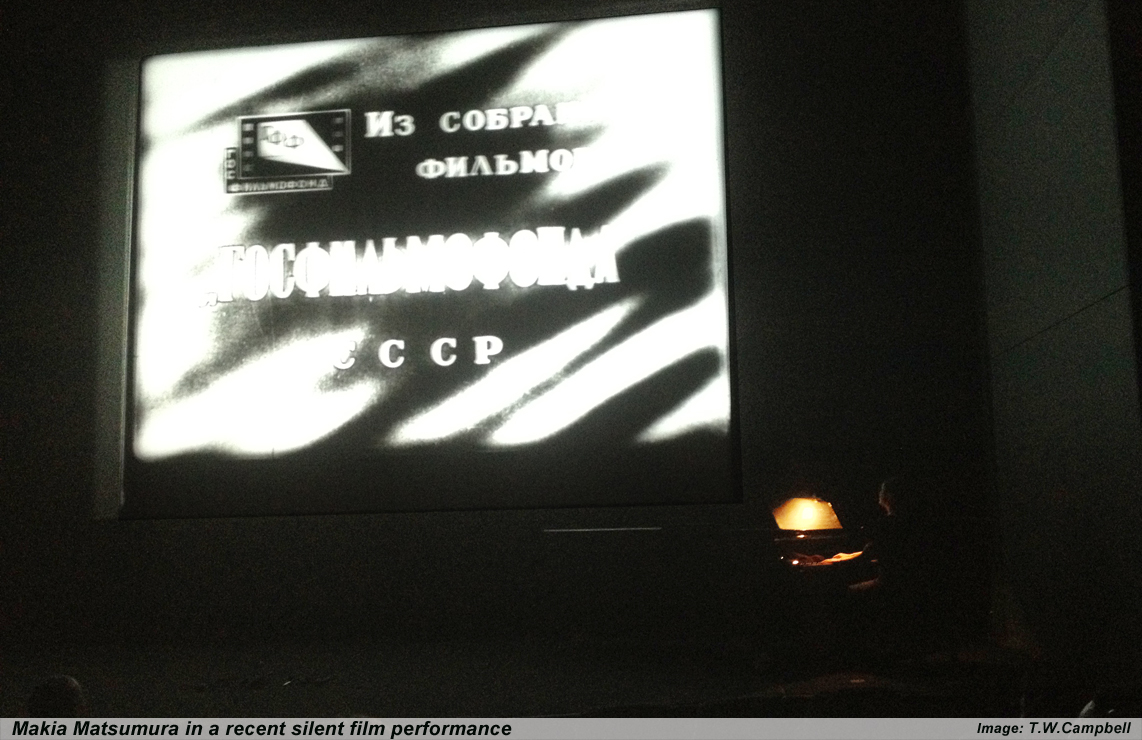
Makia Matsumura in a recent silent film performance

Thomas W. Campbell

After finishing college and moving to New York I saw my first silent film in a movie theater, probably at the Bleecker Street Cinema where I was working at the the time. Even more memorable were the occasional silent film screenings at the Carnegie Hall Cinema with live accompaniment. Silent films were never really silent and here was a link to the past, to the time when movies were performed by musicians who, at their best, really understood the art of the live cinematic experience. The Carnegie Hall Cinema is probably where I first saw Lee Erwin, an elegant man then in his late sixties, accompany a silent film. He played at least once a month, and did so with such dedication, precision, and joy that he seemed to lift the films from the past and deposit them directly into the theater. But the real revelation was hearing him perform on the huge pipe organ of the Cathedral of St. John the Divine. The precision and power of the massive organ and its towering tubes was like an adrenaline injection straight into screen.

These memories flooded back to me when I learned that Makia Matsumura, who I had met within the context of her band m2duo (a collaboration with violinist Machiko Ozawa), was performing for silent films. I was intrigued. Since 2003 she has accompanied silent films in Japan and Italy, and began, in 2008, to play in the United States, including at numerous theaters and museums in New York. She also scored the soundtrack for the Kino International DVD release of the 1923 Frank Loyd feature Within the Law. Makia first began performing at the Walter Reade Theater at Lincoln Center in 2010 and, on September 8 and 9, 2012 she performed in the Film Society of Lincoln Center series “Capturing the Marvelous: Ukranian Poetic Cinema”. Both films were classics by Alexander Dovzhenko: Zvenigora (1927) and Earth (1930). We met in the busy Indie Food and Wine Cafe at Lincoln Center before her accompaniment of the screening of Earth. Makia was gracious enough to discuss her work before crossing the street and sitting at the piano to play for an audience eager to turn back the clock to the days when films were silent but the music that accompanied them was anything but.

Thomas – What is it like to prepare for each of the films? This will be the second film that you perform this weekend. What is the preparation process like to prepare for the performance?

Makia – This time I was lucky to see the film beforehand so obviously I could learn how the story develops, what the background will be, what the visual tone of the film will be. How the story would proceed, is it an action narrative, slow paced, like that. It helps a lot to have that information. Depending on the film I might do some research. If a movie is set to a certain historic period, if there is a dance hall scene or something that might call for a specific reference to a certain type of music, then I might do some research. I might not play that exact referential piece from my research, but it helps me to get an idea as to what kind of music could go with the film.
Continue reading

Robot and Frank – Film Review

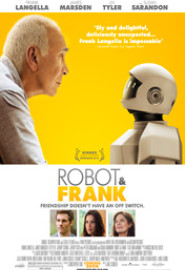
On Monday, July 30, 2012, I had the wonderful experience of leading an NBR Q and A with actors Susan Sarandon and Frank Langella following a screening of Robot and Frank. They were joined by the young filmmaker Jake Shreier, who was directing his first feature, and writer Chris D. Ford, who was also having his maiden feature experience. Each enjoyed discussing the evolution of characters from script to real-life, the experience of production, and the implications of robots in our near future. Of all the filmmakers and actors I have had conversations with, Langella stands out as one of the most compassionate and thoughtful. Some of it may have been his commitment to the role, which is the mark of a professional. But he is also unusually attentive, thoughtful, and funny.


Robot and Frank
Directed by Jake Shreier
Review by Thomas W. Campbell
Originally published on August 17 on the website of the National Board of Review.


Robot and Frank, set in a small affluent upstate new york town, is the first feature by director Jake Schreier and the story is built around a fascinating premise. Taking place in “the near future,” the film explores the dramatic possibilities of a relationship between a man who may be losing his mental bearings and a household robot. Frank Langella plays Frank, a loner who has sheltered himself into a small country house and is determined to get by on his own. He is especially dismissive of the two people who try, in their own ways, to help – his son Hunter (James Marsden) and daughter Madison (Liv Tyler). Madison is a world traveller who occasionally checks in with short video communications from far off lands while Hunter, who lives within a long driving distance, has lost patience with his father’s declining state. Meanwhile Frank’s life is becoming more chaotic, his house is a mess, and he seems to relate to only one person – a helpful librarian named Jennifer, played by Susan Sarandon. Sarandon makes much from a relatively small role, creating a warm and believable small town character who seems protective of Frank, even allowing him to lightly flirt with her. Jennifer is also facing a transition as the quaint library is being taken over by a young, rich, and very stylish man (convincingly played by Jeremy Strong). Jake is drenched in the quasi-religious fervor of a mission based on modernism and new technology. One day Frank steps up to the reference desk and is befuddled to confront, instead of Jennifer, a short squat robot  – effectively a refrigerator-like appliance with an eagerness to assist him. Later, when confronted with his son’s plan for an automated caretaker, a white robot the size of a small teenager with a blank face and helpful personality, Frank refuses to cooperate. True to the buddy-film genre, there is a gradually developing relationship about to unfold.

The screenplay, by Christopher D. Ford, is based on a short film he made in graduate school and it hits home in a number of ways: it addresses the encroachment of technology into all aspects of our lives, explores the question of how close to human the computer mind can become, and, most succinctly, gives Langella the resources as an actor to confront memory loss, old age, isolation, and the will to rise above his circumstances. Although it is not an action story the narrative moves forward in physical ways that often do not rely on dialogue.  The first thing we see, for instance, is a man in a dark room, slowly searching through drawers and desktops, peering through the shadows with a small flashlight, his half-hidden face seeming to look for anything of value to steal. But our perception of the moment is suddenly clarified when the “prowler” picks up a photograph and examines it closely. It is him (Frank) as a younger man, with his arms draped around a young man and a young woman. He is jolted by the image and we, the audience, realize that Frank is a man in conflict with his own mind.

The story plays the generational card quite effectively, pitting Frank and Jennifer against a young and encroaching world that seems intent to use technology to marginalize and ultimately replace them. She is experiencing the demise of the classical library profession, having been displaced by a work robot, and he’s been left by his family alone in the house with a metallic walking talking computer. This unlikely bond between two seemingly very alone people, will develop in surprising ways as the plot develops.

Peter Sarsgaard’s robot voice is very effective and grows on the viewer as it begins to endear itself to Frank – he sounds a lot like Hal from Kubrick’s2001, but more mellow, friendly and helpful. Not much more high tech than the unnamed robot (played by Bob May) in the 1960’s TV series Lost in Space, Frank’s robot (also unnamed) is a played by Rachel Ma, who performs inside the the costume as though it were a giant puppet. Programmed to assist Frank in every way, the robot first annoys him but then begins to get his attention with healthy meals and good advice. The narrative kicks in when Frank’s troubled past and his confused present intersect with his recognition that he can exploit the robot’s abundant skills and desire to help. There is an inevitability to the relationship that develops between the lonely senior citizen and his quaint mechanical assistant. After a series of capers that are both comic and moderately suspenseful (one involves the “liberation” of something valuable from the library that Frank touchingly and wrongly thinks will endear him to Jennifer), the story elevates the emotional stakes when it becomes apparent that Frank’s accomplice is also becoming his friend.

Langella’s enthusiasm and dedication to the role of Frank lifts the film on his broad and skilled shoulders and makes everything else feel real and believable. His portrayal of a man who is proud, aging, and struggling with memory loss is pitch perfect. An actor who has excelled on stage and screen for almost fifty years, Langella knows how to create a character in front of the camera with subtlety, nuance and conviction. There is nothing to pity or feel sorry for in the character he creates. On the contrary Frank’s ingenuity and self-sufficiency, combined with the slowly evolving acceptance of the robot as a useful and desired companion, can be seen as a hopeful celebration of how we can embrace the journey into old age – and still have fun.

Robot and Frank will play well with older audiences – but it is probably not a film that younger people will be drawn to. The robot, endearing but intentionally retro, does not have the flair of a CG creation. It has no special powers, no laser weapons, and feels more 1940’s than futuristic.  Though written, directed and shot (the workman-like cinematography is by Mathew J. LLoyd) by thirty-something filmmakers the perspective on generation Y is humorously (and refreshingly) dark. If there is cinematic justice,Robot and Frank will find its niche and do well, especially in relation to the film’s low budget. It is opening in New York City at the Paris, a boutique theater that caters to the film’s demographic and should be a good place for it to develop word of mouth enthusiasm among thoughtful film goers. Robot and Frank is a fine debut by Jake Schreier, who really knows how to let Frank Langella take over a role.

Thomas W. Campbell