
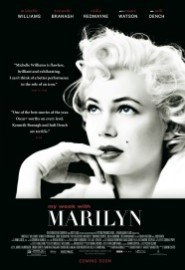
A Film by Simon Curtis
Review by Thomas W. Campbell
I moderated a Q and A with Harvey Weinstein after the NBR screening of Marilyn – it was a far ranging and quite energetic discussion.
Originally published on December 23rd, 2011 on the website of The National Board of Review.
My Week With Marilyn, directed by Simon Curtis (Cranford, A Short Stay In Switzerland), is the possibly fictional but entirely moving story of a young British man from good society who meets, and falls in love (maybe not in that order) with the woman behind the great American 1950’s icon of sex and pleasure. It’s a story that works best as fantasy yet is based on two books by Colin Clark that recount the experience – the first (The Prince, the Showgirl, and Me, 1995) a recounting of the pretty obviously disastrous pairing of Lawrence Olivier and Marilyn Monroe in the cinematic restaging of The Prince and the Showgirl and the other a further exploration of the event that focused on a special week with Monroe (My Week with Marilyn, 2000). Although he became a successful filmmaker of the arts Clark lived beneath the shadow of his father (Sir Kenneth Clark) a famous art historian and his younger brother, the conservative politician Alan Clark. Published two years before his death, My Week With Marilyn offered an experience unique enough to draw the spotlight from politics and art and shine it directly on him (and Marilyn).
My Week With Marilyn is brisk, witty, a bit sad and filled with excellent actors having a great deal of fun (even when they are spending most of their time worrying about Marilyn’s emotional instability). It is shot well, set in many of the original locations in and around Pinewood Studios, and edited in a snappy way that highlights the comic and keeps the story moving. Kenneth Branagh portrays Olivier with a flair for the melodramatic, as a man lost in the theater who cannot understand why those around him won’t simply trust the script and do the job. By 1956, when The Prince and the Showgirl was produced, Olivier had made his name as one of the great actors of British theater and expected that he would find that same success on the big screen. But his instincts were old fashioned – whatever he thought he saw in the adaptation of the play to cinema was completely ill suited for his purposes. Watched today the original film feels like a parody of everything bad that can happen to a play when it is brought to the screen – stiff overacting, sets that are obviously studio inventions, stereotypical portrayals of royalty and commoners. The irony was that Monroe brought the project to Olivier, thinking it would work for both of them. Colin Clark’s character says it best to Marilyn in the film: “You’re a movie star who wants to be a great actor, he is a great actor who wants to be a movie star. This film won’t help either of you.” Branagh gives Olivier a sense of desperation that is very likable and quite humanizing. As a director he has been given access to a talent that is pure gold in terms of cinematic value – but he has no idea how to develop the visceral and intuitive skills that Monroe brings to the table. In one agonizing sequence he stops what most likely would have been a wonderful and film enriching performance by insisting that Monroe speak a completely unnecessary word – crushing her performance with every take. It would be as if George Martin, the legendary fifth Beatle who molded their sound with love and patience, decided that they should not write their own songs and that sitars and backward sound loops would be banished from the recording studio. Most deliciously, Olivier finds himself caught between the agony of working on set and the terror of the screening room when his wife, film star Vivian Leigh (Julia Ormand) breaks into tears at the sight of Monroe’s onscreen beauty (and Olivier’s supposed admiration of it) and tells him that she hopes Marilyn makes his life hell.



 twcampbell