A Separation – Film Review

A Separation

Directed by Asghar Farhadi
Review by Thomas W. Campbell
Originally published on January 21, 2012 on the website of The National Board of Review. 

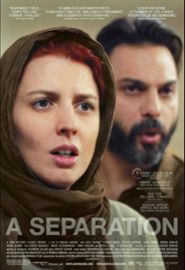
A Separation is a small powerful film by director Asghar Farhadi that tells the story of personal choices faced by a family living in modern day Iran. The film has been compared to Akira Kurosawa’s Rashomon, which in 1950 famously explored a murder from five perspectives, including that of a spirit. Like Kurosawa’s film A Separation is the story of how one unfortunate event affects many people but is almost exclusively restricted to the experiences of a middle class family – father, wife, grandfather and daughter. At numerous times, Farhadi, who wrote and directed, uses a very effective and somewhat unusual technique to create empathy for the family – a technique that Kurosawa exploited fully in his own film. A Separation opens with a shot that goes on for a number of minutes. Simin (played by Leila Hatami) and her husband Nader (played by Peyman Moadi) sit in a small office facing the camera, which has become the point of view of an authority figure who will decide if a divorce will be granted. She explains that she wants to take custody of their high-school-age daughter and leave Iran. He explains that his wife must stay to help take care of his sick father. The couple argue their case to the judge (and the audience) and we find ourselves thrust into the role of both judge and jury. We are in the middle of a complicated relationship between two intelligent and passionate people – and want to know more about who is “right” or “wrong”.

A Separation is an extremely well crafted screenplay that builds suspense by creating an evolving and volatile domestic situation in which something clearly has to give (there is a 40 day deadline before the visas to leave Iran expire). The situation is made all the more unbearable by the literal and metaphorical weight that hangs around the family’s shoulders – they must find a way to take care of the husband’s almost completely helpless father, who suffers from Alzheimer’s disease. I could follow the screenplay from the brilliant setup through the believable and quite organic story complications – but that would spoil the viewing for the many folks who have not seen the film yet. There is so much that is authentic and moving in the way that characters come together – specifically the way that the hiring of Razeh, a woman meant to watch Nader’s father, leads to a series of events that hurt everyone involved. The acting is strong and direct. Leila Hatami portrays Simin with a single conviction – to convince her family, and the judge, that she may leave Iran with her daughter. Peyman Moadi’s Nader – torn between his love of father and responsibilities to his wife and daughter – is a man caught between anger, compassion, and duty. He is also a mystery – it is unclear whether he is being cheap by not hiring qualified help for his father or whether he really is so short of money that this is not possible. Sarina Farhadi’s depiction of Termeh, their daughter, (in real life the daughter of director Asghar Farhadi), is in some ways the biggest revelation of the film. She embraces the character with an innocence that is clearly destined to crash against the rocks of life’s brutal and rocky waters. Her reaction shots reveal the toll that is being exacted on her like slow-drip water torture. There are no easy truths in the film, and even though we are restricted to the lives of Simin and Nader’s family we also begin to understand and appreciate the “antagonists” in the story – Razeh (Sareh Bayat), her hot-headed husband Hodjat, and their quiet daughter Somayeh (Kimia Hosseini). As the motivations of each person are revealed the meaning of “right” and “wrong” becomes more and more elusive.

The sound design of A Separation is remarkable – the complete absence of soundtrack music or audio effects of any kind offers no distance or respite from the world of the film. Without a musical score, or even motifs for characters or places, we are left completely on our own as we grapple with the acceleration of events and our feelings concerning their impact on the lives of the characters. Like Rashomon, we begin to understand a terrible event from an ever widening perspective – two couples, their children, the extended family, friends of the family, the people they work with, the authorities who hold the ultimate power of judgment. A Separation is an intensely realistic and believable interpretation of the Kafkaesque absurdities that infiltrate every level of society and culture.

Using a natural and realistic directing style, director Asghar Farhadi has found a nearly perfect way to bring his superbly written script to the screen. A Separation is a realistic story of personal struggle within the bureaucracy and religious society of Iran that also feels universal in its depiction of family conflict. The film richly deserves the still accumulating accolades it has received. It is assured and bold filmmaking – a critical success that is also selling tickets through word of mouth. Neither a heartwarming or action-oriented story – the film is essentially what the title suggests, a story about two people breaking up. Which is like saying that The Girl with a Dragon Tattoo is about a kinky relationship. There is much more going on – and the details are what make the experience so deeply rewarding.

Filmmaker Interview – James Szalapski

Featured

Heartworn Highways DVD Cover

I met James almost 20 years after he made Heartworn Highways. He came into an edit studio I was working at to cut a trailer of an independent film he had shot. We became friends pretty quickly, finding that we were interested in the same kind of things – telling stories, wrestling with technology, UFOs and government conspiracies (which led us both the X Files). James was an accomplished cinematographer with one of the brightest and most inquisitive minds that I’ve ever met. He liked to problem-solve especially in story telling and the technical ways we communicate them. But James was also a pioneer who moved to New York City from Minnesota 10 years before I moved to New York City from Vermont (He was 10 years older than me). When he came to the city he found an empty and essentially forgotten PreSoHo and moved into an incredible loft space on Spring Street, struggling and ultimately watching the region transform around him.

James was a pioneer who became a friend and mentor – he made a lasting impression on anybody who met him by being continuously supportive and always interested in what you were doing.

Whether shooting a documentary for PBS one month or directing a film with Roy Schneider later in the year James would always welcome the opportunity to actually tackle a new production problem – he was eternally ready to jump into life. Which made it all the more difficult for everyone when he finally passed away after and on and off battle with cancer that finally caught him in September of 2000.

Heartworn Highways is the great achievement in the life of someone who did a lot of pretty excellent things. It’s an honest and compelling look at a musical culture that was very much in transformation in 1976 – and was fortunately documented by James Szalapski and his small crew of merry filmmakers.

The following is an interview I did with James Szalapski in 1996, which was transcribed and printed in the DVD booklet that comes with the DVD..

T. Campbell:
At the time the movie was shot, and right up until the time of its original release, the film was called ‘New Country’ but then something happened which made you look for a new title. Could you tell us about that?

J. Szalapski:
They came out with a yoghurt called ‘New Country’, right while we were cutting the movie and there was advertising everywhere … we don’t want people to think its a yoghurt movie, so we changed it to ‘Outlaw Country’ for a while because these guys where referred to mostly as “outlaws,” and tried to go for something more evocative, threw round a bunch of titles and this one came together like a feeling.

T. Campbell:
You mentioned that these guys were kind of, kind of outlaws and they broke off from Nashville… Can you give us some background on that?

J. Szalapski:
Well, by the early seventies Nashville had sort of become very rigid. All the songs were sounding the same, they just turned out product like crazy and they kept country music in a narrow defined range. But the young guys wanted to do something different. A lot of them had gone through the sixties and had experienced the whole explosion in rock and pop music and wanted open it up a little bit. “LA Freeway” is kind of an anthem for these guys; they went to places like LA and New York and, and discovered it wasn’t where they belonged. Their roots were in the South and they had an emotional connection to their grandparent’s generation there. But when they came back to Nashville and to Austin, Texas they brought back with them the electric guitars and the raw sound of their own generation. But the music they were making connected more to a generation older than the one in place in Nashville.

T. Campbell:
They looked to guys like Hank Williams …

J. Szalapski:
They where looking, back to them, and I found that very interesting, this generation jump which I tried to put in the film with some of the older characters in the film. Another thing that was happening was that there weren’t a lot of places to play music in Nashville – outside of recording studios. There were very few clubs there. But in Austin there was and Austin kinda became a new capital for this new music. Austin is a university town, very liberal, pretty advanced and there were a lot of clubs to play music in. It pretty quickly became like a rival to the main, established, “religion” there in Nashville.
J. Szalpapski and friends

T. Campbell:
I wanna get into how this film was made, but I’m curious that you talked about this group of people, these outlaws.

J. Szalapski:
My connection to all this was very personal and direct. The film is dedicated to Skinny Dennis. Dennis played stand-up bass around LA. And Guy Clark was in LA at that point, this was the late sixties. The movie opens with ‘”LA Freeway” which Guy wrote about LA and he mentions Skinny Dennis in the song, “Here’s to you ol’ Skinny Dennis…” Dennis rambled around and for a time came here to live with me in New York City in seventy-two or so. Guy had gone to Nashville so he went down to visit Guy, and suddenly he felt at home for the first time in his life. When he came back he told me about the scene there and I was at the point where I really wanted to make my own film and I thought maybe this could be an interesting subject. So I went down there and stayed with him and then just met the people that he knew, Guy and Townes Van Zandt. He dragged me over to see David Allan Coe who was kind of very different from them, more outrageous, you know. He’s like the biker. And Townes is the poet and Guy is like superb craftsman/writer …

T. Campbell:
…
He’s the one who repairs the guitar in Heartworn Highways?

J. Szalapski:
He also does that too, yes. Townes would be one of those people who wouldn’t do anything for a year and then sit down and write five songs in one night.

T. Campbell:
Dennis died before you made the film. Was there any forewarning of that?

J. Szalapski:
Well, Dennis had Marfan’s Syndrome. It’s a birth defect. Lincoln had it. And it causes your body to get very boney and elongate. Dennis was six foot seven and weighed 135 pounds that’s why they called him Skinny Dennis. The doctor said Dennis wasn’t gonna make it to his twenties, you know. And, he was a pretty hard partying guy, he didn’t walk around on tip-toes because of his heart problems. Eventually he did die of heart failure. He was twenty-nine. But back in the early seventies he introduced me to everybody in Nashville and Austin. I shot slides, I got copies of their music, most of the guys only had demo’s, they didn’t have albums at that stage. I took all that around and showed it to people to try to raise some money for the thing. And they said things like “Go and get Willie Nelson or Kris Kristofferson as a host for the film” and we’ll think about it, but nobody knows any of these people. But I wanted to go with the guys who were on the way up, I think they, they’ve got the most interesting energy, they’re the avant-garde on this thing that’s happening. So, finally, through George Carroll, I met Graham Leader in Paris who became the producer of the film. He was an art dealer in Europe.

The energy crisis had just hit and the bottom had fallen out of the art market. I played him the music and the music won him over. I also showed him some of my slides. So we went to Nashville and Graham financed what we felt was going to be an hour documentary for television. I think we had thirty-five thousand dollars. In about a month we had a small crew and were underway. We shot a couple of things the first day we were there, it was great, we were off to a running start, but then we didn’t do anything for four days. People’s schedules, cancellations, we just couldn’t get anything happening. The crew was getting grumpy… but then it took off. Way led to way and we started getting other people into it. I’d say it was about two weeks into it we felt we could make a feature film. So Graham he raised more money, basically over the phones and, and we finished shooting everything we could to make a feature. The whole thing took around four weeks.

T. Campbell:
How did the budget determine the style of the film-making?

J. Szalapski:
We went as lean as we could. Me and an assistant cameraman…My assistant cameraman on was also my assistant director, Phillip Schopper. We had worked together before and had become good friends. Phillip’s a very creative person with a lot of good and you want people around you who will keep you honest. Then when we got to the editing room he became the editor and I became his assistant editor. He was there at the Steenbeck doing all the cutting and I was finding stuff and looking over his shoulder.

And of course we would always confer about the editing with Graham Leader who stayed in New York for pretty much the whole course of the finishing the film. The grip was Mike Harris, Skinny Dennis’s best friend, who was then living in New York also. Larry Reibman was the gaffer. Larry was working for a film equipment rental house at the time and wanted to get out of the rental house and make movies. The sound man was very organic. He was great. Alvar Stugard was his name. Like I would walk into a situation and start looking around for how the light- ing falls and where the lamps are, what this is gonna look like. Alvar would walk around with his microphone and his headphones on, and test the acoustics of the room, and he would find the best sound might be over in the corner and he would say what sounds best for the place what really gives the feeling of place too, you know.

T. Campbell:
This is a technical question before we move on. What equipment did you use to shoot this film?

J. Szalapski:
A 16mm camera. About sixty per cent of the film was hand-held. I shot with an Eclair, French Eclair NPR, which is a difficult camera to use, it’s fairly heavy and the weight is about five inches in front of your chest, so you’re supporting it all with your hands.

T. Campbell:
Did you a use a Nagra stereo?

J. Szalapski:
Nagra stereo. We made a real effort to record everything in stereo.

T. Campbell:
Really?

J. Szalapski:
And the final result was mag stripe stereo, 35mm film with mag stripe on the side. Because this film was done before optical stereo, you know, the whole Dolby optical stereo thing that came into movies happened about two years after we finished the film.

T. Campbell:
So not only the music’s in stereo but the presence, the dialogue track the chickens and the lambs and whatever are in stereo on the soundtrack?

J. Szalapski:
Right, and we tried to get it as high fidelity as possible but we only had two tracks so when someone was singing and playing a guitar we put one mic on the singer and one on the guitar. Then in the mix we would put their voice in the centre, where it is on the screen pretty much, but we’d spread the highs and lows out according to the position of the guitar. If the guitar neck is up to the right, you’d put the highs up there and put the lows down at the body and so we’d have a stereo separation for the scene.

T. Campbell:
Is all of the music performed live?

J. Szalapski:
Yeah. Oh, yeah. You know, people played music, like you and I are talk- ing then a couple of other people would drop over and somebody would say “I’ve got a new song”, and they try out their songs and sing together and so it goes. There was a lot of drinking, these things would go till three, four, five, six in the morning. Eventually people would sort of lose the ability to sing very well, you know, but they could still play. Their body seemed to remember the guitar stuff. I told them what I wanted to do and that I wanted to hear what they had to say about anything in this world, the movement, or whatever.

An official portrait that I scanned for Jim. Don't know yet who to credit...

An official portrait that I scanned for Jim. Don’t know yet who to credit…

T. Campbell:
So what, what happened in a sense is that you meet one person, they would introduce you to someone else, they would introduce you to some- body else …

J. Szalapski:
Exactly. Dennis was friends with Townes and Guy they’re both very highly respected in the songwriting community. They’ve written a lot of songs, they’re very original. Once they were both interested in the film people said “Oh, you should go talk to so and so”. Since Guy and Townes were my main characters people would say “Oh well, we’re in. Count us in. You’ve got those guys, we’re in”.

Continue reading

The Debt – Film Review

The Debt
The Debt
Directed by John Madden
Film Review by Thomas W. Campbell

Originally published on August 31, 2011 on the website of The National Board of Review.

On August 23rd, after a preview screening of The Debt, I led a Q and A with Director John Madden and Actress Jessica Chastain. Much of the discussion focused on the relation of director and actors – including the benefits of an extensive rehearsal process.

The Debt, the new film by John Madden, is a remake that stands on it’s own as an international thriller. With healthy doses of romance, intrigue, vengeance and redemption–the film meets the genre requirements and more. The directing is first rate (Madden’s previous films include Shakespeare in Love and Proof), the cast a pleasure of ensemble inspiration and nuance, the cinematography brisk in mobility and rich in tone, and the story is crafted with emotional and suspenseful detail.

An English-language remake of the recent Israeli film Ha-Hov (also known as The Debt), the screenplay was written by Matthew Vaughn, Jane Goldman and Peter Straughan. Although the film had a circuitous route to the screen and ultimately went from Miramax to Focus Features before finally getting a release–the final result is worth the wait.

The script itself is a thing of beauty–it provides an effective structure to the story that reveals information in a way the builds excitement and expectation. Vaughn and Goldman have previously written Kick-Ass and Xmen: First Class (both directed by Vaughn) and Straughan, who came on to work with Madden, wrote The Men Who Stare at Goats and the upcoming Tinker, Tailor, Soldier, Spy. The story takes place between two time periods which are about 30 years apart. The earlier time (1966) involves a plan to capture and return to Israel a known Nazi and war criminal known as Dr. Vogel. Though it sounds familiar this part of the story is developed in a fresh and exciting way, pitting the most vulnerable agent against the doctor (now a gynecologist), while being literally on her back. The modern period of the story takes place in 1997 (thirty years later) and confronts the repercussions of the earlier mission.

The film begins with an iconic short sequence of the three young agents leaving the back of an airplane and walking into the bright Israeli sun, obviously at the conclusion of a mission. Rachel has a large bandage covering her entire right cheekbone. When we meet Rachel in “present day” she has become famous for her actions in the 1966 mission–and her daughter has just written a book about the incident, casting her mother’s actions into the most heroic of light. Helen Mirren plays the present day Rachel and is at her very best–intense, dark, incredibly “thoughtful” (she seizes long moments to digest and try to understand the twists that fate have dealt her) and seemingly at odds with herself. Her actions and the consequences have finally caught up to her. Joining her at a fashionable book reading/release event is Stephan, her former husband, now in a wheelchair. As Rachel reads a selected chapter the film goes back to 1966 for the second time–she is reading the “official story” and what we see is a “re-enactment” of that version. When we return to the present, the harrowing events of how they captured and dealt with the fate of the Nazi doctor is truly heroic.
Continue reading

Midnight in Paris – Film Review

MidnightinParis
A film by Woody Allen
Review by Thomas W. Campbell
Originally published on June 10, 2011 on the website of The National Board of Review 

Midnight in Paris, Woody Allen’s best film since 2008’s Vicky Cristina Barcelona, was shot on a modest 30 million dollar budget and gets every cent of filmmaking value from the Paris locations and smart production design. The film opens with a song-length montage of Paris in the day, in the rain, at sunset, and in the evening. It is a beautiful and carefully constructed sequence of short iconic shots seemingly using every conceivable objective view of the city. As we move across the urban Paris landscape, a Sidney Bechet New Orleans-tinged jazz song plays in its entirety. The sequence announces two things that we can expect from the film—lots of Paris and a heavy sampling of early American jazz. With a soundtrack that features the music of Cole Porter, The Glenn Miller Orchestra, Josephine Baker, the Charleston, and the Can-Can, Allen has again demonstrated his ability to mine the history of his favorite American Music to better tell his stories.

Allen has become one of New York’s most international storytellers and in Midnight in Paris the subject (a confused writer) and setting (Paris then and now) converge wonderfully. Although Owen Wilson as Gil, the Woody Allen persona in the film, is an odd casting choice he is likable and makes the role work. Wilson is not a method actor—his acting style can best be described as wide-eyed wonder or small-eyed sadness. At this stage of his career he is a good actor who is at his best when basically playing himself, for instance in his numerous collaborations with Wes Anderson (The Royal Tenenbaums, etc.). He bumbles in a different way than Allen does. Wilson uses confusion in a slow and deliberate way, as though he will understand something if just given enough time. Allen is too nervous for calm contemplation—his first instinct is anxiety-releasing chatter.

Continue reading

My Week With Marilyn – Film Review

MyWeekWithMarilyn
A Film by Simon Curtis
Review by Thomas W. Campbell

I moderated a Q and A with Harvey Weinstein after the NBR screening of Marilyn   – it was a far ranging and quite energetic discussion.

Originally published on December 23rd, 2011 on the website of The National Board of Review. 

My Week With Marilyn, directed by Simon Curtis (Cranford, A Short Stay In Switzerland), is the possibly fictional but entirely moving story of a young British man from good society who meets, and falls in love (maybe not in that order) with the woman behind the great American 1950’s icon of sex and pleasure. It’s a story that works best as fantasy yet is based on two books by Colin Clark that recount the experience – the first (The Prince, the Showgirl, and Me, 1995) a recounting of the pretty obviously disastrous pairing of Lawrence Olivier and Marilyn Monroe in the cinematic restaging of The Prince and the Showgirl and the other a further exploration of the event that focused on a special week with Monroe (My Week with Marilyn, 2000). Although he became a successful filmmaker of the arts Clark lived beneath the shadow of his father (Sir Kenneth Clark) a famous art historian and his younger brother, the conservative politician Alan Clark. Published two years before his death, My Week With Marilyn offered an experience unique enough to draw the spotlight from politics and art and shine it directly on him (and Marilyn).

My Week With Marilyn is brisk, witty, a bit sad and filled with excellent actors having a great deal of fun (even when they are spending most of their time worrying about Marilyn’s emotional instability). It is shot well, set in many of the original locations in and around Pinewood Studios, and edited in a snappy way that highlights the comic and keeps the story moving. Kenneth Branagh portrays Olivier with a flair for the melodramatic, as a man lost in the theater who cannot understand why those around him won’t simply trust the script and do the job. By 1956, when The Prince and the Showgirl was produced, Olivier had made his name as one of the great actors of British theater and expected that he would find that same success on the big screen. But his instincts were old fashioned – whatever he thought he saw in the adaptation of the play to cinema was completely ill suited for his purposes. Watched today the original film feels like a parody of everything bad that can happen to a play when it is brought to the screen – stiff overacting, sets that are obviously studio inventions, stereotypical portrayals of royalty and commoners. The irony was that Monroe brought the project to Olivier, thinking it would work for both of them. Colin Clark’s character says it best to Marilyn in the film: “You’re a movie star who wants to be a great actor, he is a great actor who wants to be a movie star. This film won’t help either of you.” Branagh gives Olivier a sense of desperation that is very likable and quite humanizing. As a director he has been given access to a talent that is pure gold in terms of cinematic value – but he has no idea how to develop the visceral and intuitive skills that Monroe brings to the table. In one agonizing sequence he stops what most likely would have been a wonderful and film enriching performance by insisting that Monroe speak a completely unnecessary word – crushing her performance with every take. It would be as if George Martin, the legendary fifth Beatle who molded their sound with love and patience, decided that they should not write their own songs and that sitars and backward sound loops would be banished from the recording studio. Most deliciously, Olivier finds himself caught between the agony of working on set and the terror of the screening room when his wife, film star Vivian Leigh (Julia Ormand) breaks into tears at the sight of Monroe’s onscreen beauty (and Olivier’s supposed admiration of it) and tells him that she hopes Marilyn makes his life hell.

Continue reading